
Words that matter
what togetherness means

More learning
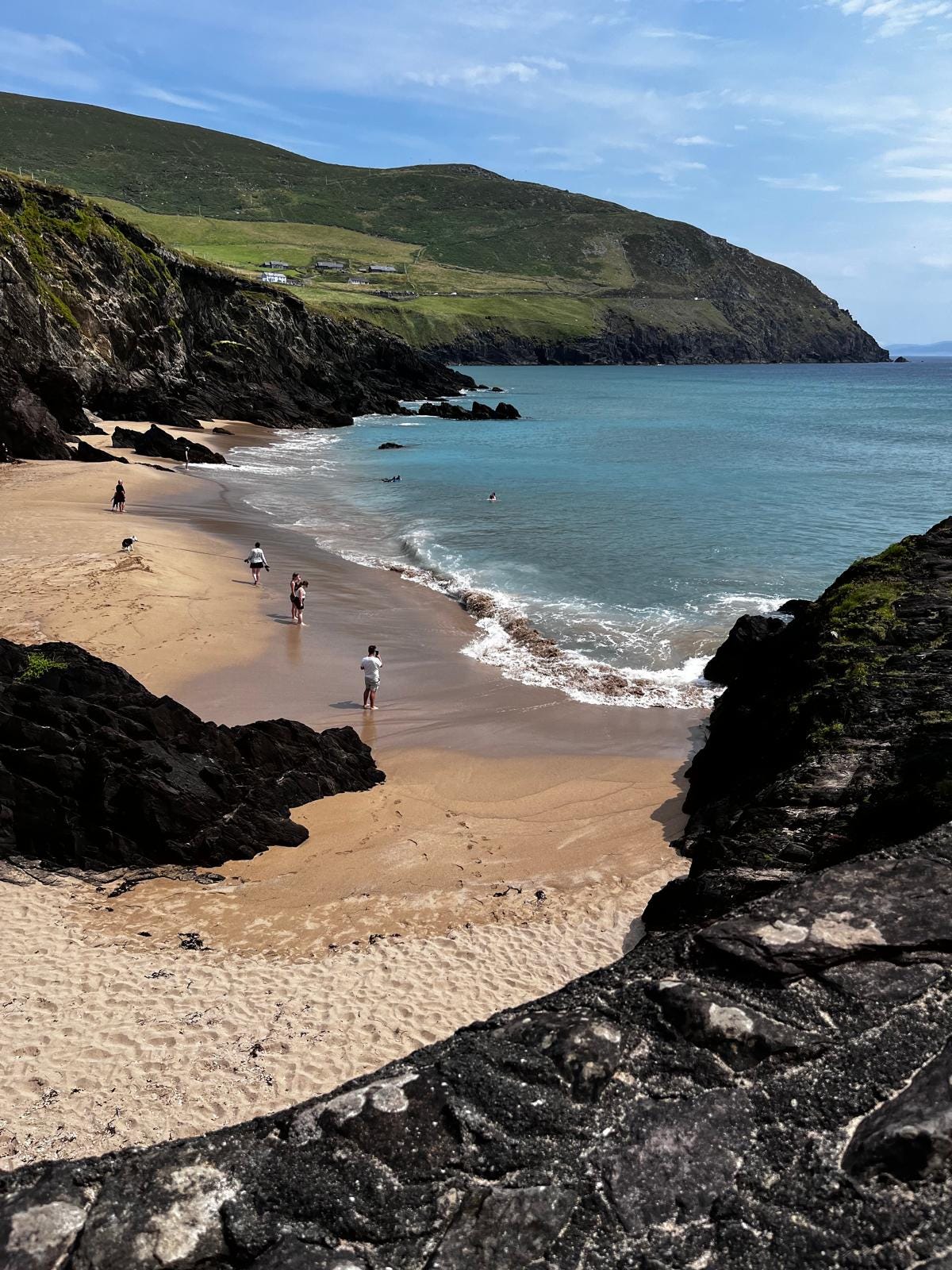
As some of you know from Notes, I am in Ballyferriter this week doing an Irish course. Again, I’m aware how vulnerable it is to be learning another language—and how joyful and exhilarating. I first wrote about this “roller coaster” after being on this course two years ago (The Thrill of Victory, the Agony of Defeat). That year my classes were in the middle school; this year, I am in the primary school, with children’s art and vocabulary (numbers, months of the year, days of the week) on the walls as Gaeilge (in Irish). Someone complimented me this week on my blas (accent)—which also means in Irish “taste” or “flavor.” Yet being back in this pre-school room reminds me how far I’ve come on this language-learning journey and how far I still want to go. I am still often struggling to understand what’s being said or to find the words to speak.
“…people tend to have more words for the things that matter to them, whether they be chisels or elves or salted, fermented sea herring…” —Laura Spinney, Proto: How One Ancient Language Went Global
This week I met again too the word bothántaíocht: visiting houses specifically for pass-time, conversation, and socializing. My teacher here this week (a local, native Gaeilgeoir) said this included music and story telling. I love that there’s a single word in Irish that sums all this up. It comes from the Middle-Irish bothán meaning a hut or cabin. The very huts then where people lived (in the 18th and 19th centuries) came to be synonymous with community and connecting. The root of this word is thought to go back to the Proto-Indo-European for "to grow, appear, or dwell.” It conjures up small, interdependent clachans where people lived, farmed and socialized together—working during the day in meitheals and at night, visiting hut-to-hut. There is even a phrase in Irish: Bheith tugtha do na botháin (“to be given to visiting”) in this way.
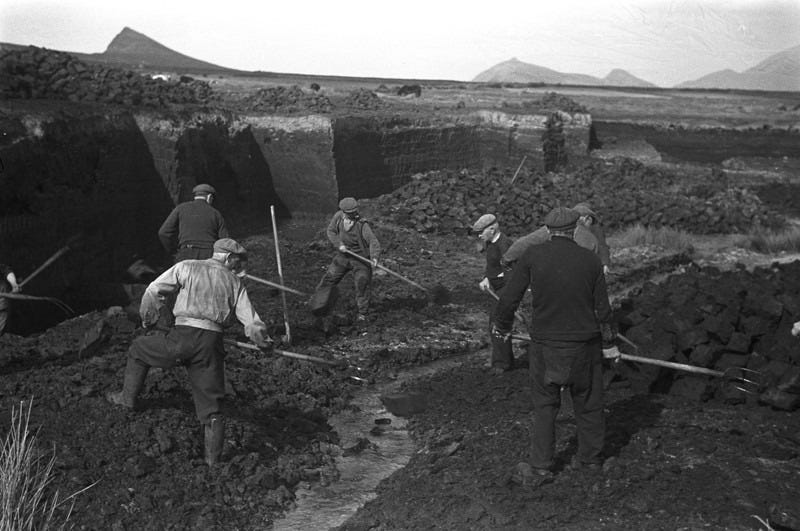
Thinking about all this, I wanted to share again the essay (Sheltering Each Other) where I write about the meitheal and its significance. I think it’s one of the seminal essays I’ve published in The Gaelic Effect. It first appeared in October of 2024 (and now here with some updates). It was also inspired by my time in Ballyferriter two years ago. (By the way, one of the historic photos in this essay—of cutting turf—is from Ballyferriter.) Revising this essay, I am feeling wisftul; when first publishing it, Manchán Magan (who I reference here) was still alive.
Before we jump in to that essay, I want you all to know that the next Grá Mór (“Big Love”) raffle will take place on Sunday, August 2nd. Thank you so much for being here—for reading, commenting and sharing and for your on going support of The Gaelic Effect. I would not be here without you. An extra, very big thank you to paying subscribers: Míle buíochas (“a thousand thanks”) to each of you. See the very cool Grá Mór prize here.
Being together
This summer at Irish school in Ballyferriter, mo mhúinteoir (my teacher) repeatedly used the word meitheal even when speaking English. He would write a sentence in Irish up on the board, for example, “Ní raibh gearán riamh faoi iomarca fear meithle,” and then below it, the English translation, “There has never been a complaint yet about there being too many in a meitheal.” The word “meitheal” was always there, in Béarla agus Gaeilge (English and Irish). He finally explained that there simply is no direct translation for this word in English.
In my last essay, What’s Love Got to Do with It?, I explored how the word céile (from le chéile, meaning “together” or literally, “with each other”) forms the underlying meaning of “husband,” “wife” and “spouse” in Irish and how céile appears in many other expressions. In Irish, trína chéile means “mixed up, confused, or upset;” literally, it means “through together” as in cutting through or separating togetherness. Separating or dividing what is otherwise connected—breaking up what’s coherent and whole—seems an apt way to say “mixed up” in a language-culture where togetherness is so highly valued. For me, the importance of le chéile in Irish (in all its forms) speaks directly to meitheal and its significance in Irish culture. It is a further extension of le chéile thinking. Literally, meitheal means in Irish, “linked to the other.”
The Meitheal
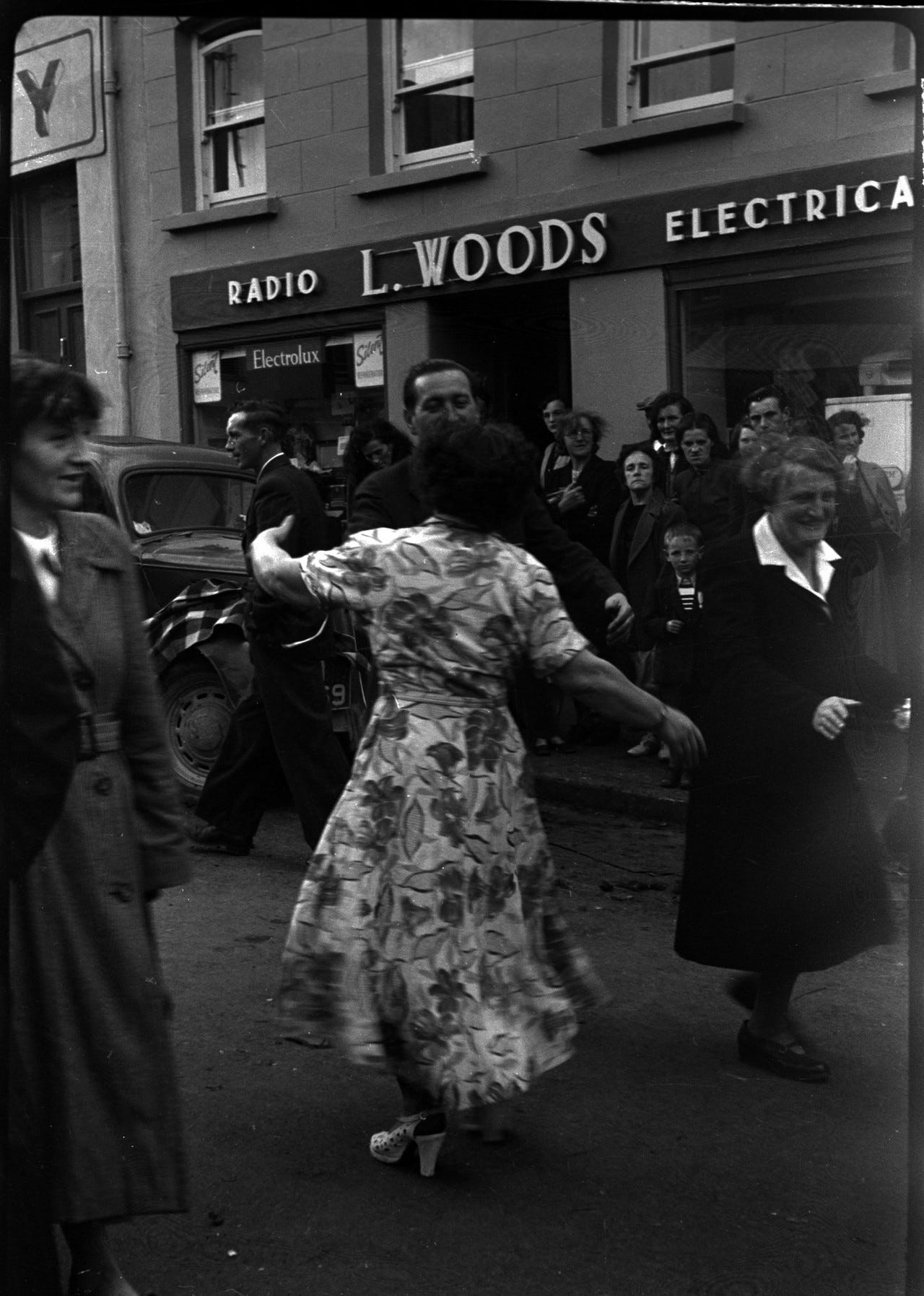
Similar to Amish barn raising, a meitheal is a cooperative work party focused on the greater good, an expression of community and interdependence. This is not staff working together (that’s foireann, a sports or office team). The meitheal is a traditional, co-operative labor system where groups of neighbors help each other in turn, such as in thatching, harvesting, digging potatoes, or cutting turf (peat). “…[T]he heart of the concept is community unity through cooperative work and mutually reciprocal support.” More than just working together, it’s about “a common purpose […] for each other to ensure that all succeed in achieving their goal.”1 Hillary Clinton popularized the African proverb, “it takes a village.” In Irish, there’s a similar proverb (or seanfhocal, wise words): Tógann an t-oileán an t-ógánach, “it takes the whole island to raise the youth.” This kind of relational thinking informs the meitheal.
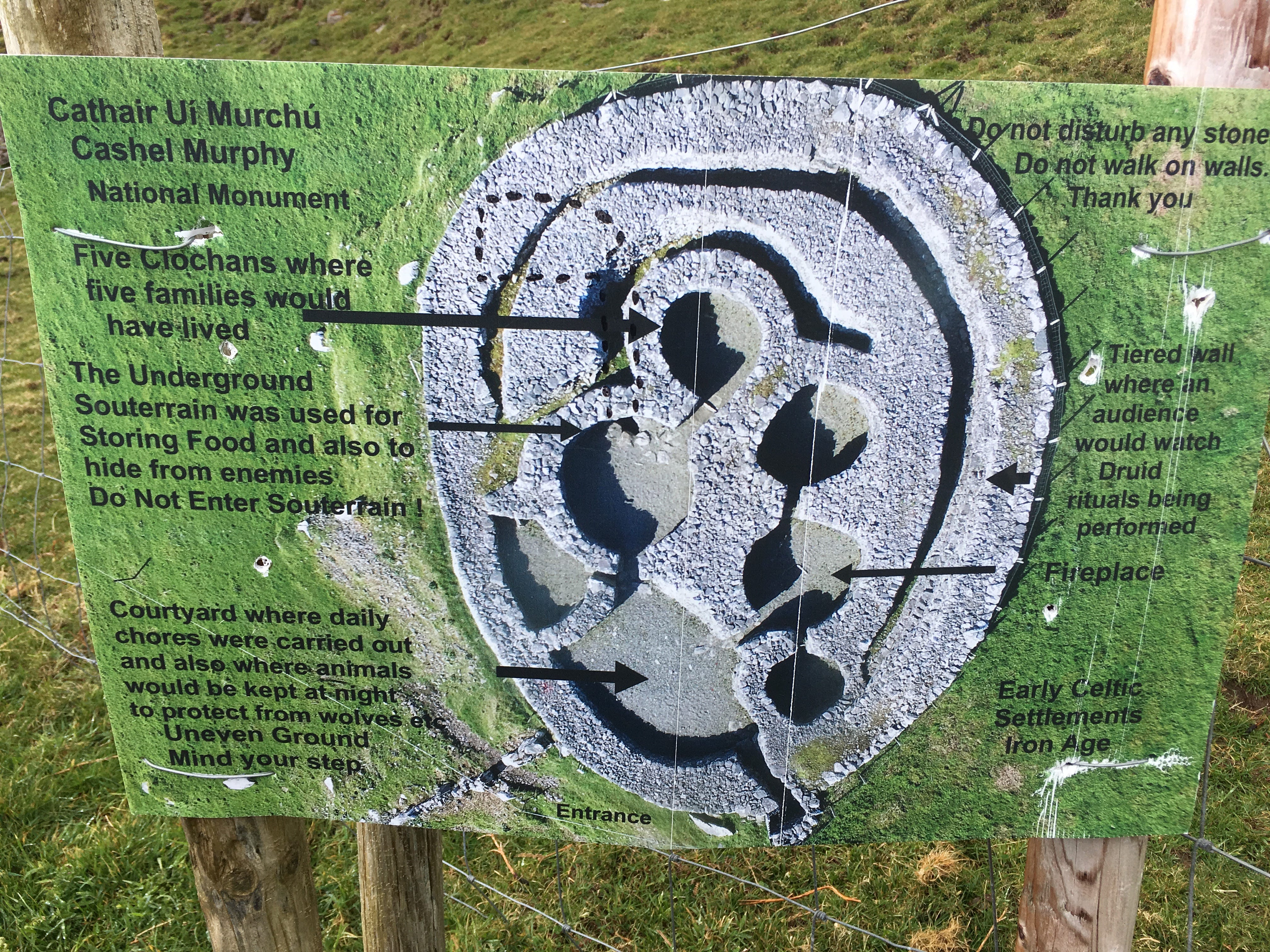
The cooperative values of meitheal can be seen in other aspects of indigenous Irish culture, including clachans and the rundale system of farming. The rundale system, “well attested in ancient Ireland,” shows “a continuous tradition of partnership.”2 Shared plots for grazing cattle on less arable land, “rundale” comes from the Irish words roinn, refering to the division of something, and dáil, meaning meeting or assembly.3 So literally, the rundale system was the bringing together (or meeting) of what otherwise would be divided. You may recognize this word today in Dáil Éireann, the Dáil referring to the Irish assembly or parliament. Clachans, “a small settlement of clustered houses,” were similarly a collective form of living, with cottages grouped around the most arable land and the shared “rundale” plots for cattle in the further “out” fields. In Estyn Evan’s book Irish Folkways, he describes clachans and the rundale system in detail, including diagrams of how clachans were organized.
British colonizers characterized the Irish as disorganized since cottages in clachans seemed scattered, lacking a discernible plan or order. In actuality, “the selection of a house-site was the matter of the most careful deliberation,” based on sheltering houses (“snuggling” them together) from the prevailing winds.4 What seemed haphazard to an inexperienced eye in fact was a carefully planned system where one cottage protects the next. The rundale system was also criticized as unable to accommodate the demands of population growth and at late stages the clachans were often congested and overcrowded. Yet both systems show a collective way of living together and sharing resources that supported the whole community’s survival. The rundales continued through the nineteenth century, their demise “the result of incoming [colonial] landlords who began impound[ing] cattle trespassing on their property and charg[ing] prohibitive retrieval fines.”5
“Meitheal is the Irish expression of the ancient and universal appliance of cooperation to social need.” —Mary Robinson Centre
The meitheal continues to be meaningful in Irish culture today. Numerous organizations make use of the term, such as Meitheal Mara, a maritime education and community boat yard; Mountain Meitheal, a volunteer group maintaining nature trails; Meitheal Artist Support; and diverse initiatives for families, children and teachers, including music, tutoring, anti-bullying and leadership development.
Meitheal as Community in Action
The botanist Diana Beresford-Kroeger in effect was raised in a clachan and benefited from a kind of child-rearing meitheal. Born in 1944 to an Irish mother and an English father, when both her parents died she spent each summer with family in Lisheens. In To Speak for the Trees, she writes:
“There was a Catholic church three miles away in Kealkill, which acted as a gathering place. The public nurse, Nurse Creedon, had a nearby office. […] But other than that, there really wasn’t a “town” to speak of in Lisheens, just a collection of family farms and labourers’ cottages on either side of the river. About a thousand people were living in the area and I was related to all of them in one way or another, though often only distantly.”6
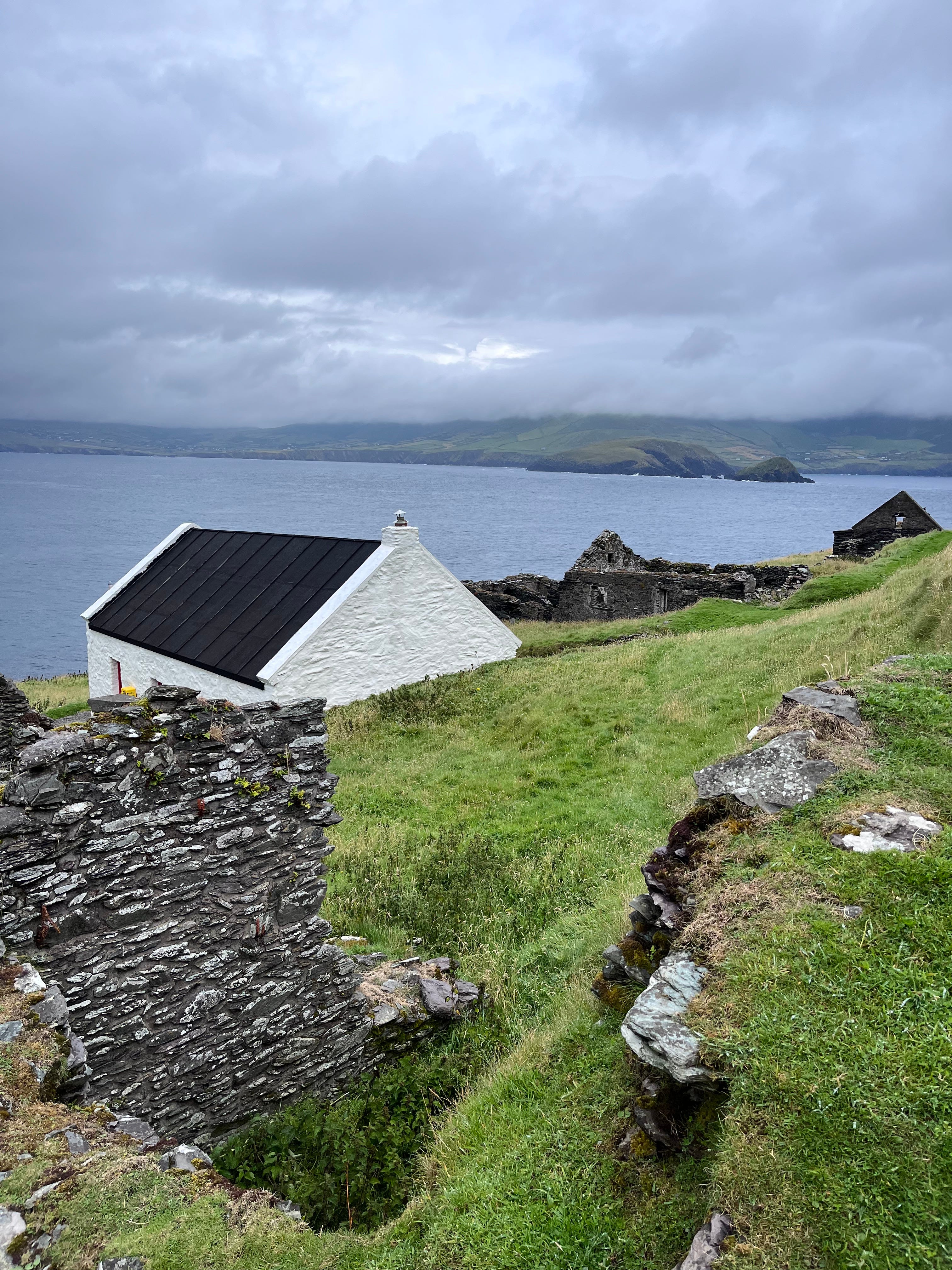
Though she doesn’t herself call this a clachan, how she describes Lisheens matches every description of a clachan. I’m fascinated that this way of living still existed and thrived as late as the early 1960’s in Ireland, especially given that sources say clachans had long disappeared by then.
More, the whole “clachan” took on educating Beresford-Kroeger in a kind of parenting meitheal. Just like the rundale system of farming, this practice of fostering had continued for more than a thousand years, going back to the Brehon laws:
“There was an almost tangible generosity of spirit in the air. […] The Brehon laws of hospitality were still a strong as they had always been, and according to those laws, as an orphan, I became everyone’s child. Even the poorest of the poor felt that it was their privilege to give me something, if only a single ripe Bramley apple, or the choice gooseberry from their gooseberry bush outside their front door, or their first ripe strawberry.”7
Beyond care for her physical well being, as a “Brehon wardship,” she was trained by the entire Lisheens community with traditional knowledge about how to identify and use herbs, prepare different kinds of butter (with milk from different times of the year for different uses), care for animals and do farm work. They also gave her psychological and spiritual guidance.
Ireland: An Indigenous Culture
Many are finding parallels between indigenous Irish culture and indigenous cultures across the world. Manchán Magan has written about this, among others. According to Howard Zinn, the historical evidence shows that before the arrival of Columbus, the indigenous people of the Americas (similar to the Irish) lived in highly cooperative, organized, and peaceful ways. Columbus called them “barbarians” but the Aztecs had running water, genetically engineered crops, and well organized urban streets larger than European centers. Mann, in 1491: New Revelations of the Americas Before Columbus, confirms these and other details. As Bartolomé de las Casas, a contemporary critic of Columbus pointed out, colonialism destroyed this way of life forever.
I read A People’s History of the United States decades ago but these details stay with me. I also remember Zinn’s point that many would consider these facts a romanticized form of primitive communism, idealizing indigenous people. But Zinn emphasized that this is not the case. All the evidence shows that indigenous people really did live largely in peaceful and cooperative ways. This is also supported by the work of Rianne Eisler, who, in The Chalice and the Blade (a book Marshall Rosenberg often recommended), shows how in pre-history this kind of partnership-based society was the norm. These cultural values continued in some form in Ireland (perched on the far western edge of Europe) for far longer than other parts of the western world. The Irish language, one of the oldest in Europe, shows the remnants of this way of seeing and being.
Longing for Meitheal Today
In Irish, there is an old expression, ar scáth a chéile a mhaireann na daoine, “people live in each other’s shadows.” None of us can survive without the other. In clachans, this was literally the case: each house was situated so as to protect the others. Today, how do we take collective action towards a common good? How do we reconnect to the spirit and practice of the meitheal? How do we connect with this sense of interdependence across national interests and borders? In classical rhetoric, this was the consistent, underlying question: “What is the greatest good?” All arguments came back to this point. Meitheals, clachans, and the rundale system of farming all seem (even with their limitations) as the “greatest good” in action: an effort to think of the collective for everyone’s benefit. During these times of grotesque greed and corruption—and when the GOP once again is threatening to strip social security—the clachans and meitheal remind us of how we can relate to each other. To me, it seems the very purpose of government is to function as a large meitheal, or at least in the spirit of one, for the betterment of all. How do we share resources in a sustainable and just way? How do we focus on the greatest good? Surely our collective future depends on it.
Slán go fóill, by for now, and thank you again for reading and being here,
Dian, i mBaile an Fheirtéaraigh an tseachtain seo (in Ballyferriter this week)
Irish Folkways, E, Estyn Evans, pp. 23-4
Irish Folkways, E. Estyn Evans, p. 30
To Speak for the Trees, Diana Beresford-Kroeger, p. 30
Ibid, p. 31
Love the note about Howard Zinn’s research. I find a lot of white people love to say we’re “romanticizing” Indigenous cultures when we talk about them being more egalitarian or in better harmony with nature, but to me it feels like an easy way to exclude yourself from any wrongdoing on your ancestor’s part. It’s also a very colonial mindset in itself, this idea that if we say something positive about pre-colonial cultures, we’re saying they’re perfect and colonial cultures are evil. There’s no nuance to it; every culture has its problems and every culture has its beauty. Thank you for sharing this research.
(Also, I posted a note on the Scottish Gaelic worldview and encountered some comments from men like I have mentioned above. But for the most part, people are curious to engage with the world in new ways.)
I really enjoyed this article. When I married in New Orleans our wedding cake had 'Le chéile go deo' written on top. 🌹