
Doing What We Can
Unlikely heroes

A chairde (Friends),
Thank you so much for being here and reading The Gaelic Effect! A special thank you to subscribers (I appreciate you!) and especially paying subscribers. Thank you so much for all your love and support.
Tá sonas domhain orm (I have the happiness of the world on me) to announce that Donna na nDarach has won this month’s Grá Mór raffle—a consult with Fen. Congratulations Donna and thanks so much for your support! Be on the look out for the next Grá Mór raffle, and other special “gratitude gifts” coming up.
Want to become a paying subscriber yourself? To celebrate The Gaelic Effect’s two year anniversary—Yes! We’re now two!—for the next week you can become a paying subscriber at a 25% discount! Upgrade here and thank you so much again for believing in me and this project.
And now, this week’s Gaelic Effect…
Do what you can
In the satirical black comedy and coming of age story set in Nazi Germany, JoJo Rabbit, the hero and his mother [spoiler alert] see a group of executed people left hanging in the public square, a public warning to resistors. The ten year old JoJo asks, “What did they do?” His mother responds, “They did what they could.” This becomes a refrain in the film—including when (further spoiler alert) JoJo’s own mom is killed by the Nazis. In the face of power-over and oppression, what meaningful action do we take when it can seem overwhelming and hopeless—when everything is distorted, crazy making, and even dangerous—our whole world turned upside down? Even JoJo—dealing with it all, including the horrifying execution of his mother—reminds himself in the end: “Just do what you can.”
In the face of overwhelm, it can be easy to do nothing. When the problems are this big, it would demand, it seems, even bigger, braver, more courageous responses. How can I possibly do anything big enough to make a difference? As Piglet said, “It’s hard to be brave when you’re a small animal.” It’s all so exhausting and overwhelming—and that too is no coincidence. Flooding the zone is right out of the Nazi playbook. It is designed to be crazy-making: to overwhelm, confuse and dis-empower. In the face of that, “Do what you can,” is freeing. There are two parts to it: Do something. + What you can. What is true—authentic, joyful, comfortable (though maybe not completely comfortable?) for you to do? If it’s nothing right now—or an action as small as Piglet himself—that’s okay. Pressuring or shaming ourselves helps no one. We already live in oppressive times. Why oppress ourselves more? If it’s action that boosts understanding, connection, kindness and empathy—or creativity and expression—in these times, it’s political.
Unlikely heroes
This concept of “do what you can” creates unlikely heroes. Two of my favorites right now are Joanne B. Freeman and Heather Cox Richardson. Both are historians in their early sixties. They are not comediennes or pop or reality TV stars (the last of which led to the current resident at the White House) or even young, flash or tech-savvy (in fact, they often struggle with technology). Their popularity flies in the face of anti-intellectualism and the anti-expert mentality rampant in the U.S. (leading also to our current predicament: from an algae infested reflecting pool—who cares what science says?—to the inexperienced and untrained negotiating nuclear deals, leaving us worse off than before). Yet they are increasingly in the public eye. Last July, Heather Cox Richardson was on the 2025 Times 100 Creator’s list; she continues to be the most subscribed author on Substack; as of last year, she was reported to have over 3 million subscribers (Letters from an American), over 3.2 million followers on Facebook, and over a million on Youtube. Her friend and collaborator, Yale professor Joanne B. Freeman, is an award-winning historian and leading expert on early American politics, political violence, and Alexander Hamilton. She appears frequently on PBS and the History channel and is famous for her groundbreaking books and the primary consultant for the musical Hamilton. Across platforms, she has almost one and a half million followers.
Their work is imbued with “What can I do?” They are living examples of it: doing what they can do by sharing their critical analysis and expertise in U.S. history. The periods they specialize in have high relevance: the founding of the nation, the Civil War and Reconstruction (many have wondered if the U.S. will have a Civil War again? Now some say there’s a civil war within the Democratic party). They already had significant impact as academics; they could have rested there. Yet they tirelessly share their expertise, both in how they communicate concepts (breaking down complex ideas, treating their audience with respect) and in the frequency (both offer live, daily news updates where they answer questions), plus a weekly live chat together. While Trump attempts to take the U.S.’s 250th birthday hostage (with a green reflecting pool, a triumphant arch for himself, and a fight ring at the White House), Heather Cox Richardson has created a series of brief videos for the anniversary, celebrating the achievements of every day Americans (250 to 250). This is consistent with Joanne’s repeated message: “We.” They are clearly on a mission to save democracy.
In these times, facts can be a revelation. Here’s Richardson sharing jaw dropping historical quotes for context:
During a time when humanities budgets and departments have been slashed and even dismantled, they are a living reminder of why learning history and civics—and the humanities as a whole—matter. (Another reason they’re my heroes!) They are able to offer—as probably no one else can—historical context and perspective. Yes, we are experiencing unparalleled authoritarianism, cronyism and incompetence. Yet we are not the first generation to deal with racism, xenophobia, gross concentration of wealth, distortion of facts, gerrymandering and the obstruction of justice and voting. If you’ve ever read A People’s History of the United States (which covers all the history left out in high school), you will be familiar with much of the U.S.’s checkered past. Democracy has always been a fumbling work of progress in the U.S. Yet context is everything. Richardson reminds us that past times of uncertainty were also highly creative and transformational periods. People then too responded to the question, “What can we do?,” made changes, and re-took their power.
People doing what they can…
The Irish language is also an unlikely hero. British colonialism did everything it could to kill her. For over a century, she’s been an endangered or vulnerable language; until recently, many thought she wouldn’t make it. Yet she (the language) is currently experiencing a revival. I am not the only one enamored with her. So many people delight in aspects I discuss here in detail: the psychological awareness implicit in the language (with feelings being “on” you—not who you are; a deeper connection to feelings—such as “sorry” being “sadness on you, or “mourning” literally being “under sadness”); a different awareness and articulation of togetherness and community (from the meitheal to how and how often le chéile—togetherness—occurs in Irish); to a very different way of relating to ownership and the natural world (Irish leads with the verb—reflecting how, in indigenous Irish culture, all the world is alive; there’s no verb for “to have”—instead, all that we “have” is relational). There is a deep level of self-connection and discernment implicit in an teanga (the language)—seen, for example, in the concept of maith (goodness) and ceart—not what is morally or superficially right but intrinsically true. In each of these words and structures, there are riches: layers of meaning, nuance and history. I encourage you to explore the archive of The Gaelic Effect to learn more about these concepts and how each connects to others, creating a web of culture and meaning that, I believe, is truly insightful and inspiring.
As a U.S. citizen living in Ireland, I wrestle regularly with this question: what can I do? The Gaelic Effect is my primary response. To some, it may not seem a dramatic political act of resistance. Yet it’s what I can do—with my expertise (in applied linguistics and Irish cultural studies) and my background in empathy and human connection (from years of teaching Nonviolent Communication). It sometimes feels as if the The Gaelic Effect is the culmination of a life time of disparate work, with all my passions converging in an unlikely and happy way. It’s something I never could have predicted. Five years ago, I didn’t think I’d be living back in Ireland, learning Irish, or writing again in the area of Irish studies. Given my background and interests, it’s not completely surprising. Yet I didn’t see these different aspects of my life converging in this way. I hope through The Gaelic Effect that I create insight, connection and community; that I move and inspire you; that I create beauty. I hope I open up new possibilities—about what we’re capable of as human beings.
As a bonus, I hope you also learn some Irish—or start any language originally not your own. I see immense benefit in learning another language, in opening up new worlds and ways of seeing and also learning—through the inherent challenges of learning a language—more about yourself.
For now, I invite you to consider: What are you called to do? What are you doing, already? How are you an unlikely hero? I want to remind you that, in the face of an oppressive regime, that kindness is medicine. Human connection matters. Even small acts can be radical interventions.
Thank you again for being part of this journey over the last two years, for being part of the community here, and little heroes for The Gaelic Effect.
Grá mór (big love to you),
Dian (i mBaile Átha Cliath—in Dublin)
P.S. Hear the pronunciation of Irish words and phrases in different dialects at https://www.abair.ie/ Just copy and paste.
P.S.S. Why become a paid subscriber? I spend about twenty hours researching and writing each essay, plus more time each week taking photos and posting Notes. What I earn (after Substack’s cut) isn’t much—but it helps with what I spend on Irish lessons each year! More, with paid subscribers, I can write off those expenses—which makes a big difference. I hope you’ll upgrade now (if you haven’t already) and help celebrate The Gaelic Effect’s second birthday! The 25% discount runs for the week! GRMA (thank you) again, a chairde (friends)!
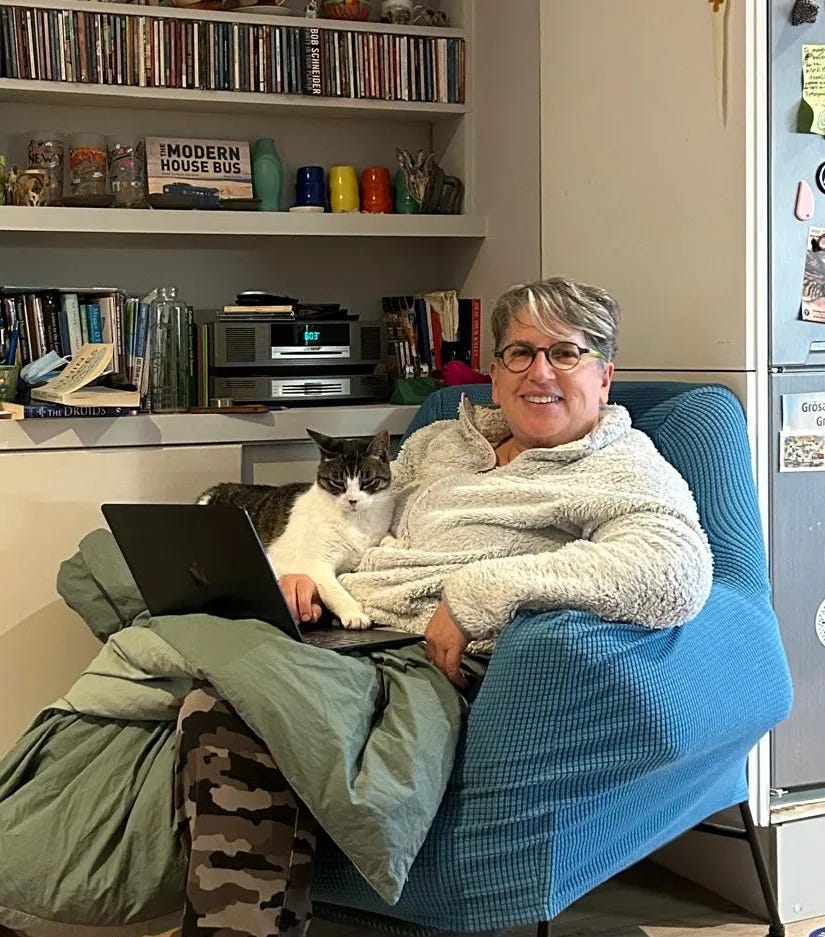
Or support The Gaelic Effect and its mission by “buying me a cupán tae —making a one-time donation anseo (clicking here).


This reminds me of what Joan Baez said about living 85% in denial to avoid becoming extremely depressed, and then using 15% to help a little fish. She talked about how we can't turn the tide on the problems of the world all alone, but we can save some fishes. Whatever fishes you want to focus on, whatever calls to you issue-wise.
Love this reminder to "do what you can." Every morning, upon awakening, I say to myself, "Everything that happens to me and around me is necessary. I view it all as necessary, and I will do the work that is mine to do." It's not always easy to know what that work is, but I keep asking.