
Exponentially Expanding
Welcome to the living, abundant, generative world

The habitual…
I still remember a film I saw when growing up. The main character was an American spy, posing as a German officer. No one suspected he was American. Then during a meal, after cutting some meat, he switched his fork back to the right hand. In Germany, and most of the world, rather than the “cut and switch” method, you keep the fork in your left hand when eating. He was immediately identified as a spy.
Last week I visited An Siopa Leabhar, Dublin’s Irish language bookshop. I was looking forward to speaking as Gaeilge, with my cúpla focal (few words of Irish). All I really needed was Rinne mé ordú ar liné; Dian Killian is ainim dom. (I placed an order on line; my name is Dian Killian) and—instant gratification—I would receive my bag of Irish language goodies. Yet out of the gate, I blew it. When I came in the door, the staff person said Dia duit (“hello”). Without missing a beat, I replied Dia duit back. That might seem a perfectly reasonable response: someone says “hello,” you say “hello” in return. Except in Irish, when someone says Dia duit (“God to you”) you say in resonse, Dia is Muire duit (“God and Mary to you”). Just like the spy reverting to eating with his right hand—old habits die hard!—my default English language reflex (“hi” for “hi”) outed me as a Gaeilgeori beag (baby Irish speaker).
Progressive expansion…
Irish is not the only language where an initial greeting is responded to with a different, set response. In Swahili, how you say “hello” depends on the social status of the person you’re speaking to. With the most formal “hello,” Shikamoo (“I hold your feet”), you respond marahaba (“I accept your respect”). If you say Hujambo (“How are you?”) the set response is sijamboIn (“I’m fine”). In Arabic, the initiator says As-salamu alaykum ("Peace be upon you"); the responder says, Wa alaikum assalam ("And upon you peace"). Yet in Irish, the different responses don’t stop with the first exchange. The blessings keep expanding: after God and Mary comes Pádraig (one of Ireland’s patron saints), then Bríd (Ireland’s female patron saint). In some dialects, Joseph is included. Here’s a visual graphic showing the standard responses to each consecutive “hello” in turn (thanks to Niamh Ní Fhainín for the graphic):
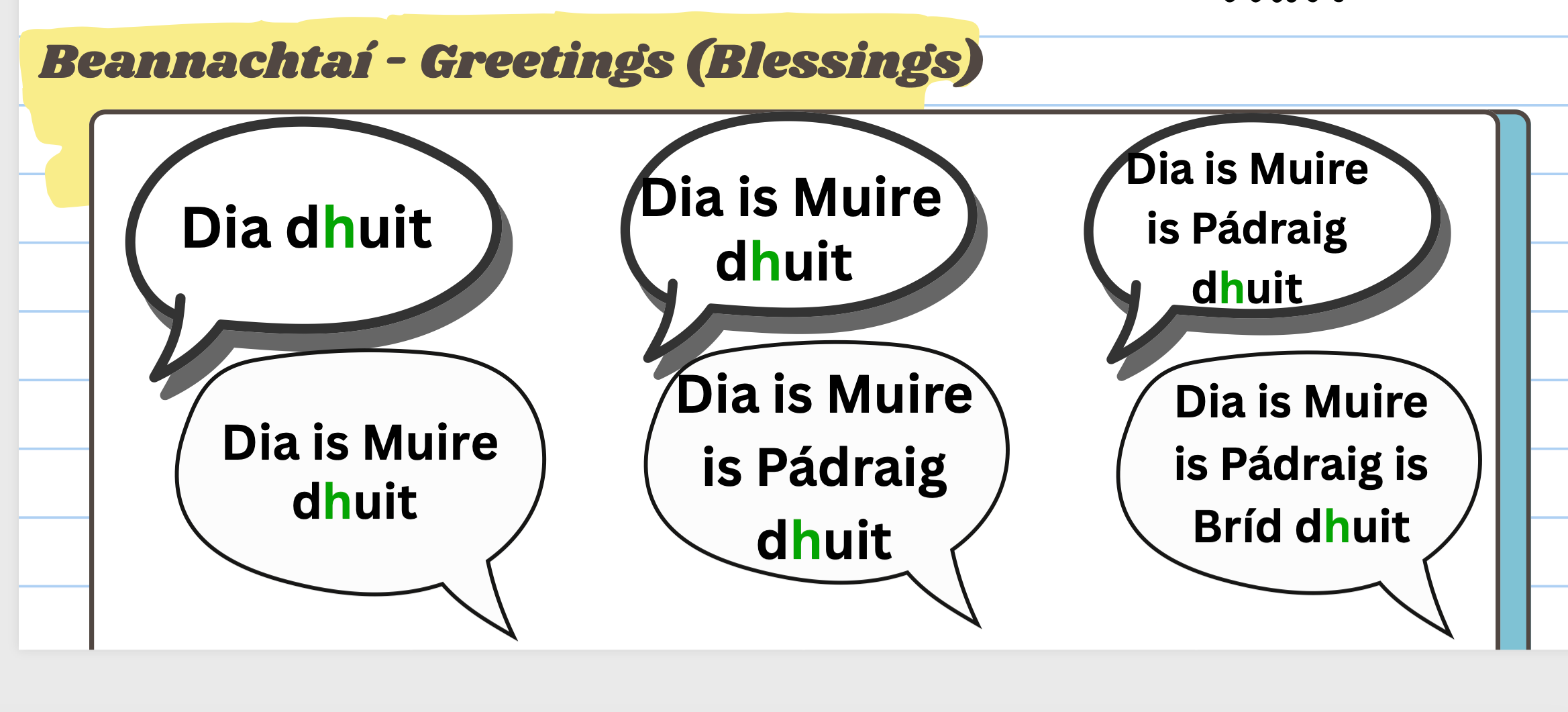
The is here means “and.” So when someone says Dia duit, “God to you,” you say back, “God and Mary to you,” and they then respond again by adding, “God and Mary and Patrick to you.” You can then say back, “God and Mary and Patrick and Bridget to you!” As an aside, is (pronounced “iss”), is an abbreviated form of agus (the Irish word for “and”). In English, we use “n” as as short version of “and.” In Irish, the abbreviated form is so common that it’s part of the formal way of saying “hello.” It’s so standardized, you don’t apostrophize it (as we do in English: ‘n’) to indicate that letters are missing. Structurally, this makes it easier to include all those saints, with the Irish “ands” rolling off your tongue.
Irish is the only language (I have found) where the “hello” greeting progresses and expands like this. Today, you rarely hear more than the opening exchange (God and Mary) yet it does happen. If you know the person, you can also just ask, Conas atá tú? (How are you?), or as they’d say in Munster, Conas tánn tú? with different responses possible (thár bar, “great,,” or go dona, “not well,” go holc, horrible, etc). Often you hear Aon scéal? (“What’s new?”—literally, “What’s the story?”). This is the Irish version of “¿Qué pasa?” The most common response to this is Diabhal an scéal!—”no news” (literally, “Devil the news!”) or Scéal ar bith (“No news at all”). Yet while these are common exchanges with different possible responses, the formal way of greeting someone (especially for the first time) involves the Dia duit progression.
Tá Dia láidir is máthair mhaith aige. —God is strong and He has a good mother.
As I’ve written previously (see All of Us Gods), I find it moving and significant that the way you say “hello” in Irish is in effect a blessing. This is a far cry from English (again, Us Gods) where “hello” is transactional; its etymology goes back to “hey,” to get someone’s attention. (As my mom used to say when I was growing up, “Hay is for horses”). The very word for “greetings” in Irish is beannachtaí, literally blessings. In effect then, all greetings in Irish are blessings. This reminds me of how, when writing someone in Irish, you address them as “friend” (see Everyday Friendship). How does extending a blessing to each person—rather than just getting their attention—impact how we see and relate to each other? What is the composite impact of a language where each person is blessed and addressed as a friend, each time you interact with them?
A living, generative universe
The bookend to this is that traditionally in Irish you don’t swear at people, you curse them (see Close to the Bone). This may not seem significant, yet a basic practice of Nonviolent Communication is to avoid judging people or putting labels on them. Cursing someone wishes a bad (and often humorous or deadly outcome—again, see the Bone), yet it isn’t static; it doesn’t define or put someone in a box of being a certain kind of (“bad,” “evil” or “stupid” or whatever they are) person. All of this allows for change and possibility.
This is consistent with another aspect of Irish that I’ve explored in The Gaelic Effect: that Irish expresses a world that is highly alive, fluid and changeable (see A World Pulsing with Life). We see this in feelings being “on” us (not permanent or part of our intrinsic identity); we see it structurally, in that the verb comes first (rather than the subject, or agent) so what’s alive or happening matters more than who is doing it; you find it in the structure of verbs, including the “do be do-ing” form which doesn’t quite exist in English and other languages and is hard to fully translate; the closest to it in English is the simple present tense, but that habitual tense (“I wash dishes,” “I go to work, “etc) is static sounding with a repetitive rather than active, breathing quality. Greetings in Irish follow this pattern. It’s not just a pat and simple “hello” and “hi.” It’s a generative, living and expansive universe, where numerous saints (and good wishes) are exponentially wished upon you.
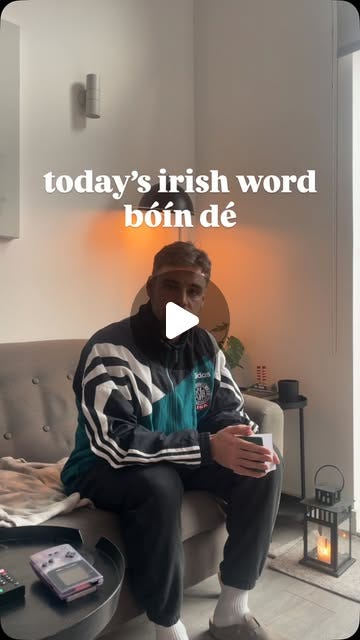
In this aliveness is a recognition of liminality. When blessing someone, you intrinsically recognize that forces larger than any of us are at play—forces we can call on to aid us, or (in the case of curses) invoke harm. It positions the human being and human agency in a very different way; we can’t see or control or fathom all of it. This world view reminds me of Asian art where the figure of the person is very small in a huge, encompassing landscape. In Ireland traditionally (and still for some today) there is deep respect for the sídhe, the fairy folk who are very much connected to the land and the awareness of larger, unseen forces that can bring good (that pot of gold) but also, especially if not respected, havoc and harm. This awareness of liminality moves through the Irish language. One simple, beautiful example is the word for ladybug, bóín dé, God’s little cow. This short video explains the origin of this word and how it recognizes the help of unseen forces, be they of nature and/or the sacred:
Seeing the unseen
Especially in a post-Catholic Ireland, Dia duit and invoking the saints (or even referring to an insect as God’s cow?) can be uncomfortable for some. Yet going back to Old Irish, Dia far precedes Christianity. Bríd is both a patron saint and a pre-Christan goddess. That Dia duit involves the Saints and a series of blessings speaks to much more than Catholicism; it expresses a broader and deeper view inherent in the Irish language and indigenous Irish culture that respects nature, magic, the unseen, and the sacred. Manchán Magan in his work repeatedly describes this awareness as a constant; traditionally, Irish people were aware, in every moment and in every task—from invoking the saints while raking embers in the hearth to when baking bread, cutting the dough to release the faieries—that the unseen was at play. I have a sense that Dia duit and Dia is Muire duit, in all its iterations, at least traditionally, is an expression of this far deeper, older, and intrinsic awareness.
Dancing with abundance
In this traditional greeting there is also inclusion, balance and equality, with the feminine (Mary and Bríd) equally recognized and included. Tá Dia láidir is máthair mhaith aige. (God is strong and He has a good mother). This in itself connects back to much older roots in Irish culture—fitting for a country named for Ériu, a goddess of sovereinty and fertility. The very name of the goddess has its origins in the Proto-Celtic word meaning “fertile land.” This equality and inclusion is seen in other ways in the Irish langauge as well, such as in the egalitarian fear chéile and bean chéile (see What’s Love Got to Do with It?).
Finally, in this living, breathing, bigger-than-any-of-us world of equality, inclusion and fertility, there is intrinsic generosity and abundance. That “hello” grows like bunny rabbits in Irish is consistent with other aspects of the language. It’s not enough to just welcome someone in Irish, though you will see the world fáilte on its own, for short. Yet rather than Tá fáilte romhat (literally, welcome is before you), you usually get some exponential version: Fáilte is fiche romhat (twenty welcomes), or Fáilte is céad romhat (one hundred welcomes), or Céad míle fáilte romhat (one hundred thousand welcomes). This is similar to thanking someone in Irish where, rather than just Go raibh maith agat (“goodness to you”), you will hear Go raibh míle maith agat (a thousand good to you) or sometimes (at least in Kerry), “míle, míle” for short. Just as you go from God, Mary, Patrick to Bríd when saying “hello,” you also go to a place of generosity and abundance in welcoming and thanking. It’s all connected—from the same tapestry of connection, abundance (fertility) and generosity.
I hope this essay, like a bóín dé (God’s Little Cow), is a blessing for you,
Dian (i mBaile Átha Cliath—in Dublin)
P.S. It’s time for another Grá Mór (Big Love) raffle! Check out details and a photo of the prize here.
Or support The Gaelic Effect and its mission by “buying me a cup of coffee” —making a one-time donation anseo (clicking here).


This is gave me chills...! Wow. The Irish language is amazing. And you are an amazing writer!
I really get why you love the Irish language so much. I mean, to receive a blessing every time someone greets you just melts my heart.