
Aliveness and Uncertainty
Seeing binary moons

Time shifting
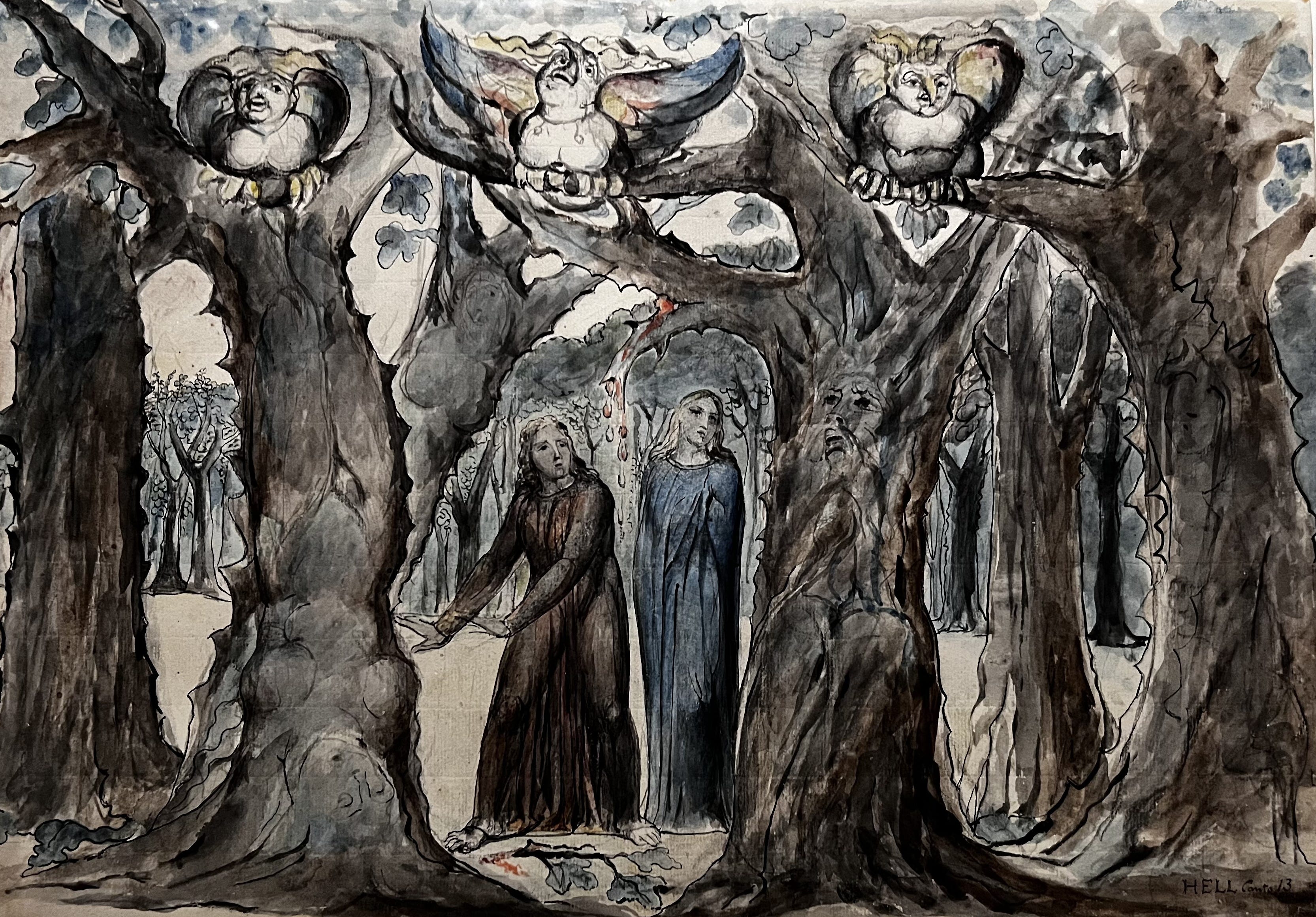
A few days ago I passed a man in Dublin wearing a t-shirt declaring, “FEAR THE FUTURE!” I smiled and said, “I think we’ve enough to fear already!!” He agreed. For sure, we’re living in edgy times. I know in the past, people survived intensity. That’s why I find Heather Cox Richardson so reassuring; she talks about current affairs (no matter how surreal) with the measured, long-view of an historian. I can only imagine living through the Bubonic plague and how gruesome it must have been. It’s estimated that half the population of Europe perished; the survivors were sure it was the end. It’s also easy to romanticize the Romantic period, including the French Revolution (as least we do in the U.S., since aligned with our own triumphal independence). Yet I was recently reminded through the William Blake show at Ireland’s National Gallery just how bloody and riotous the French revolution was; combined with the Industrial Revolution (more social upheaval) and a huge volcanic eruption in 1816, people widely believed the world was ending. Yeats (having lived through the horrors of World War One), also thought it was the end-times.
Again, we seem to be living the apocalyptic. My generation has already seen a lot: 911 (I was living in New York City), COVID (also in NYC then—when excess bodies were stacked in refrigerator trucks and buried in mass graves); now we’re living through the break down of international norms and increasing authoritarianism and aggression. Things fall apart: stability, standards, agreements, expectations. The White House is (partly) demolished; a UFC arena being built there (we think temporarily—but who knows?); those who stormed the capital on January 6th and smeared shit on the walls are being financially rewarded. It goes on and on. Dealing with climate change—which we are just beginning to see the impacts of—would be enough, without everything else collapsing. In Ireland, it hit over 85 degrees Fahrenheit in May and in New York, over 90 degrees in April. None of this is normal. Climate change is further increasing food instability, mass migration, illness and plagues. What is slouching forward to be born (as Yeats put it)? None of us know.
Aliveness and uncertainty
I do know that within indigenous Irish culture, there is a persistent awareness of uncertainty, through liminality. When two worlds co-exist—one often unexpectedly erupting into the other—nothing is completely stable or as it seems. Time and the material world collapse and are wobbly. This awareness is fite fuaite, woven into and inextricably connected with Irish ways of being. These co-existing worlds interlope and collide trína chéile, mixed up and (as trína chéile suggests) literally moving through each other. When someone is kidnapped by fairies or unexpectedly falls into the other world, the two worlds collapse. Clearly, depictions of unstable reality occur not only in Irish culture—Alice in Wonderland, The Wizard of Oz, and, most recently, the hyper-Post-Postmodern film, Everything, Everywhere All At Once, all include unpredictable, shape-shifting qualities that distort time and place. Yet in Irish culture, it’s not just in stories or art. It’s a systemic, underlying way of experiencing reality. As I wrote about in The Full Stature of Fairies, it’s not just metaphorical or historical; this awareness and respect for the other world persists today.
Increasingly, I experience the Irish language as a shape-shifter herself. An teanga (the Irish language) is a particular kind of magic mushroom that takes me to a very different place than English (or Latin or French—other languages I’ve studied). It’s a different way of seeing, feeling, and being. Fite fuaite and trína chéile themselves are such beautiful and specific terms (not easily explained in English) that embody—even in how they sound—this kind of moving-and-meeting energy. In some ways, the Irish language is a wild world—a multi-dimensional rubric cube of interconnected, moving pieces. I’ve explored in earlier essays about how highly relational, non-static, alive and non-hierarchical the Irish language is (see Debt or Abundance? and Being Together). The English language inhabits a more stationary (and perhaps falsely confident) world. How do I know this? It’s all about being.
Open to change
In English, there is only one verb for “be.” We can use verb tenses to distinguish between what’s habitual and what’s happening now (and is impermanent); we express this in English via the continuous (progressive) tenses: “I work” means I do that everyday; “I am working” refers to something temporary or what I am doing right now. We can of course use the “-ing” form of the verb “be” to refer to a temporary state or what’s happening now (“You are being pedantic!)” This means I may not be pedantic (in your opinion) all the time, but I am acting that way this moment. Yet when it comes to states of being, in English we have only the one linking verb, “be.” In that world, everything becomes quickly static. “I am a writer” or “I am American,” defines who you are as much as “I am sad,” “I’m itchy,” or “I’m thirsty.” In Nonviolent Communication, contrary to standard English, we use the continuous form of the verb intentionally for this reason—“I am feeling sad”—to remind us that this is how I am feeling now: it’s not who I am, all the time; it’s open to change and likely will.
When I first started learning Irish and saw sentences with “is,” I was ecstatic. “Yay!” I thought. “Is” is the same in both languages—familiar and easy. Go P.I.E! (Pindo-Indo-European—the meta language both English and Irish descend from). Yet it’s so not the same. First of all, is is pronounced “iss” in Irish (not “izz”). More significantly, I then discovered there’s another word that also seemed to be “is.” How can there be two? It’s like that moment in Star Wars when Luke steps out of his house and you first see the binary sun. It’s stunning, but you do a double take. Two suns? What kind of world are we in?
In Irish, there is the copula, is, and the substantive form, most often used in the form of tá. Like other aspects of the Irish language radically different from English, this is often challenging for learners. When to is and when to tá? This becomes even more trying when you remember there’s no “yes” or “no” in Irish (see Yes or No?). As you often hear in Hiberno-English as well, you respond with the negative or positive form of the verb (“I am” or “am not;” “it is” or “it isn’t”). So you need to know which verb to use—both when speaking and responding. For example, “Are you cold?” (An bhfuil tú fuar?) would be replied to with tá (if you are cold). If someone says, “yes” to An múinteoir thú? (“Are you a teacher?”), they would reply sea (the affirmative of the copula). All these “be” questions (regardless of tense) start with the same question word, An. So there’s no way to know out of the gate which form of “be” to reply with (is or tá). You need to listen for what comes after the An and the whole structure of the sentence. You need to know the rules.
Little boxes
Basically, you use the copula (is) when putting people or things into categories—identifying, classifying or equating, so it’s often followed by a noun. These are often static or unlikely to change categories. For example, Is scríbhneoir mé (“I am a writer”); Is as Nua-Eabhrac mé (“I am from New York”); Is Meiriceánach mé (“I am American”). Is í an dochtúir an bhean. (“The woman is the doctor.”) Sometimes there’s no noun, but “person” or “thing” is implied or understood (an American person). When describing someone, their existance, or states of being, you use tá, so it’s often followed by an adjective. These are more often temporary or changable conditions or locations: Táim sa bhaile. (“I’m at home.”) Táim i mo chónaí i mBaile Átha Cliath. (“I live in Dublin.”) Táim sásta. (“I am satisfied.”) Tá an aimsir go dona. (The weather is nasty.) Here are examples contrasting the two:
Is duine óg í (“She is a young person”) <> Tá sí óg (She is young.)
Is scríbhneoir mé. (“I am a writer”) <> Táim ag scríobh. (I’m writing.)
Is cait súgartha iad. (They are playful cats.) <> Tá na cait súgartha. (“The cats are playful.”
Regarding the cats, this is far less pronounced in English (lacking the two different forms of “be”), and the second sentence (Tá na cait súgartha) tells us about how the cats are acting now rather than the kind of cat they are.
“Linguists would rather share each other’s toothbrush than each other’s terminology.” —Eörs Szathmáry
Some of this is idiomatic. When expressing likes, dislikes and preferences, you use is: Is maith liom é. Is breá liom é. Is fearr liom é. (“I like it. I love it. I prefer it.”) Literally, these mean, “It is good with me,” “It is fine with me,” and “It is better with me,” so in effect you are putting things in categories (what is fine, good, and better). I actually find it touching that, while friends can come and go, in Irish you use the copula when talking about them. “She is my friend:” Is í mo chara í. There is another way of expressing states of being in Irish using tá with “in” and a possessive pronoun (“in my sitting,” “in my standing”), giving further insight into states of being in Irish. We saw an example of this above in Táim i mo chónaí (literally, “I am in my living…”). This brings “being” to a whole other level in Irish.
In effect, is is not even a verb. It doesn’t conjugate or connect to personal pronouns the way verbs do in Irish. It’s just a grammatical place holder; linguists call it a particle or auxilary. When something is alive in Irish, when refering to a state of being, you use an actual verb: tá. My experience is that tá (suggesting being, impermanence and the transitory) is used far more often. Google (and A.I.) agree: Tá is far more common—estimated to be used up to fourteen times more than is. Tá is a heavey lifter in Irish, used for a lot of tasks and communication: weather, health, moods, locations, and continuous actions. Is is like glue—it sticks nouns together. Not a lot of movement or aliveness there. The Irish language is mostly focused on what’s alive.
Meeting the impossible
When you speak a more static and non-relational languge like English, all these moving parts in Irish can feel overwhelming and even impossible. You need to be paying attention all the time—at least I do, as a non-native speaker. Yet it’s great aerobics for the brain; it’s apt training for volatile times. Liminality, change, instability (and possibility) often go together. At the end of the day, even when chaotic and seemingly digressive, I believe we are part of an evolving world. In Irish culture, this aliveness is deeply rooted in the natural world. I don’t want to experience aliveness only in the context of chaos and uncertainty and disorder—I also want to notice ripples moving on the water, the flight of birds, how the clouds shift. We are surrounded by aliveness, even in big cities, if we look for it.
Maybe liminality was the indigenous Irish way of make sense of the uncertain and unpredictable. The Irish know all too well about how unpredictable and even dangerous nature and the world can be, especially on the Atlantic-facing west coast and when out at sea (or when crops fail—and the ruling government exploits it). I wonder sometimes if the elaborate belief system in fairies and larger-unseen forces is a way of making sense out of what ultimately can’t be predicted or controlled. When something goes missing, or a child’s health or behavior changes, or some other misfortune occurs, it can be blamed on the fairies and not respecting them. It gives meaning to what can seem meaningless, hapless and cruel. Maybe it’s just a rabbit-foot in your pocket: an amulet to hold on to. Maybe it’s better than grasping nothing at all. Yet, as the Irish language shows us, this is where the aliveness (the act of being) is. How do we navigate it all—being a very small boat (a curach) on a big (and volatile) sea? Personally, I want to lean into being. I want to remember that part of the equation is about possibility. It’s in the liminal (even when scary) where aliveness happens and magic can occur.
Thank you for being here. I appreciate your companionship and support. If you’re not yet a subscriber or paying subscriber, please consider becoming one—it means the world to me. There’s also another Grá Mór raffle coming up, my way of thanking you. Regardless, please know you make a difference.
Hoping this essay today has helped you find meaning in chaos and being, with grá mór (much love),
Dian (i mBaile Átha Cliath—in Dublin)
P.S. The most special Grá Mór (Big Love) raffle is coming up! Fen, a highly skilled carrier of the old ways through star-craft, divination, astrology, dreams and the rose, is generously donating a reading. All paying subscribers are entered to win! We’ll also be doing a live call Monday, 8th June, exploring Hellenistic astrology (an older and more insightful form) and other practices aligned with indigenous Irish culture. The drawing is June 21st. Thank you again for reading The Gaelic Effect and everyone (gach duine) who subscribes, especially paying subscribers. Thank you!
P.S.S. Hear the pronunciation of Irish words and phrases in different dialects at https://www.abair.ie/
Or support The Gaelic Effect and its mission by “buying me a cupán tae —making a one-time donation anseo (clicking here).


An-suimiúil! "Tá is far more common—estimated to be used up to fourteen times more than is."
Mar a dúirt tú, tá mé ag streachailt le "When to is and when to tá?" To is, or not to is, sin é an cheist. :)